18+ · Research use only

Supply for clinics, med spas and wellness centres
For practices adding a peptide line to a room, a client base and a service menu that already exist.
Most practices that come to us are not starting a peptide business. They already have treatment rooms, a booking system, a client list that trusts them and a service menu that works. What they are doing is adding a line to it, and the questions that come with that are supply questions rather than startup questions: can you hold stock, can you restock against my appointment book, and what happens when I run out on a Friday.
Everything we hold sits in Metro Manila cold storage rather than a warehouse abroad, which is the difference between a restock measured in hours and one measured in weeks. For a practice running a standing schedule, that is the part that decides whether the line is worth carrying at all. The failure mode of practice supply is not price, it is a gap in the calendar.
We are a peptide supplier. Everything we hold is designated research use only. It is not sold for administration to patients, and nothing on this page tells you what any of it does to anyone. A practice buying from us is making its own regulatory decision, and we would rather write that plainly at the top than bury it at the bottom.
Every price we publish is already public
Before anything else: every price this business publishes sits on published pack pricing, including the ten-vial rate, which is the best number we print. It is open to anyone with no conversation and no account. If a pack covers what your practice uses in a month, you already have our number.
An account is for what a catalogue transaction cannot do:
Volume above a pack
Past the point where a pack is the right unit, our own supplier prices deeper and that is passed through. Quoted against your actual order rather than published, because a standing monthly figure and a one-off are different things.
Allocation against your book
Stock held against your appointment volume, so a compound you use every week is not competing with retail demand for the last vials on the shelf.
Sourcing outside the catalogue
Seventeen compounds are stocked and the sourcing route is wider than the list. Ask rather than assuming.
Kits at every order size
Consumables ship with every order, scaled to quantity. What ships in the box sets out the contents.
Adding a line, not starting a business
The practices that make this work are not the ones that treat it as a new venture. They are the ones that already have the expensive parts and are adding a line to them.
Consider what a peptide business actually requires. Premises a client will walk into. A booking system. A client base that already trusts you enough to say yes to something new. Staff who can handle a vial without being told twice. Cold storage. A reason for someone to be in the building in the first place. A med spa or aesthetic clinic has every one of those already, paid for, running, and currently being used for something else six days a week. The marginal cost of adding a peptide line to that is stock and a shelf.
That is a fundamentally different proposition to the one a standalone reseller faces, and it is why the economics look so different from the inside. A reseller is paying for customer acquisition on every single order. A practice is adding a line to a conversation it was already having with a client who is already in the chair. The acquisition cost is close to zero, because the client is not being acquired. They are being asked a question at the end of an appointment they booked for another reason.
The constraint is not demand and it is not premises. It is supply reliability, and this is where most practices get caught. A service menu item that is available in March and unavailable in April is worse than one you never offered, because the second one costs you nothing and the first one costs you a client's confidence in everything else on the menu. Once a treatment is on the menu, the supply behind it has to be as dependable as the room and the appointment slot, and a practice sourcing from an overseas shipment cannot promise that.
This is the whole argument for local stock in a practice setting. Not that the vial is cheaper, but that the line on your menu stays true. A restock measured in hours means you can put something on the menu and keep it there. A restock measured in weeks means you are periodically taking it off, which is the thing that actually costs money, because it does not just cost the treatments you could not deliver. It costs the credibility of the menu.
The honest version of this: it is not free money and it is not passive. You are taking on stock you have paid for, storage you have to manage, records you have to keep, and a regulatory position that is yours rather than ours. The section below on what is not on offer sets out exactly where that line falls, and it is worth reading before the pricing conversation rather than after.
What in the catalogue is relevant to an aesthetics practice
Three of the seventeen come up in aesthetic and dermatology contexts more than the rest. Described here by what they are, not by what they do to anyone, which is the line this page does not cross.
GHK-Cu is a copper tripeptide complex, a short peptide bound to copper, supplied as a 50mg lyophilised vial. It is the compound most associated with topical and cosmetic formulation research, and the blue colour in the vial is the copper itself rather than a dye.
GLOW Blend is a co-lyophilised 70mg blend, and KLOW Blend an 80mg one. Both combine several peptides in a single vial rather than requiring separate vials to be reconstituted individually, which is why practices tend to ask about them: it is one item to store, one to record and one to handle.
What none of those descriptions include is an indication, an outcome, a protocol or a dose. That is not an oversight and it is not us being cagey. These are not approved products in the Philippines or anywhere else, no regulator has cleared them for a use, and a supplier writing treatment claims for a clinic to repeat is manufacturing a liability for both parties. The full catalogue with what each compound is and what it costs is on the marketplace.
How supply fits a practice that already runs
You have an inventory process. This is about slotting into it rather than replacing it.
- 01
Restock cadence against appointment volume
Tell us roughly how many vials a month your book consumes and we hold against it. The useful cadence for most practices is a standing order sized to a month with a top-up route for a busy week, rather than reordering each time something runs low. That way the reorder is a message, not a scramble.
- 02
It slots into your existing stock process
Every vial carries a batch number, which is what makes it recordable in whatever you already use. If you log lot numbers against a treatment record you can do it here the same way. We are not asking you to adopt a portal or a separate system.
- 03
Cold storage in a clinic setting
Sealed lyophilised powder is stable in a freezer and tolerates a fridge. Once reconstituted, a vial belongs in the fridge and should not be frozen. In a practice the practical constraint is usually not temperature but traffic: a treatment-room fridge that is opened forty times a day cycles more than a dedicated one, so a small separate unit for stock is worth more than a bigger shared one. Handling and storage detail is in storing peptide stock in the Philippines.
- 04
Delivery to the practice
Sealed, freeze-dried vials from Metro Manila cold storage, plain outer packaging with nothing on the box describing the contents, batch numbers on every vial. Metro Manila is same-day on weekday orders confirmed before the cutoff. The rest of the country is 1 to 5 business days by region, and we confirm the window before you commit rather than after.
- 05
Invoicing
If you need a BIR-registered invoice, say so in the first message. It is a common ask from practices and it is far better settled before the first order than discovered at payment.
What arrives with a practice order
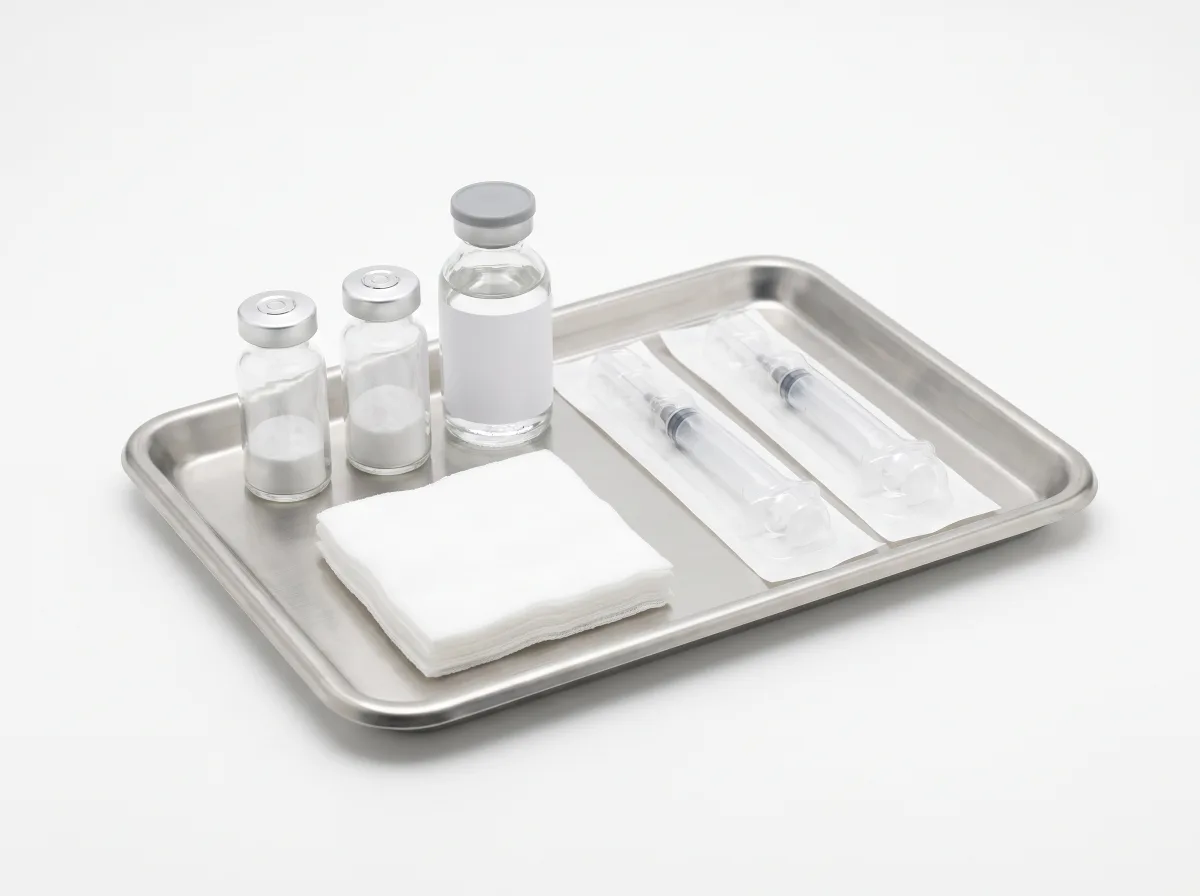
Bacteriostatic water, insulin syringes, alcohol prep pads, a reconstitution syringe and blank labels, in the box, scaled to the order and included rather than charged.
For a practice the value is not the consumables themselves, it is that the order arrives complete and does not generate a second procurement task. Reconstitution supplies are not on a separate lead time from a separate supplier with a separate minimum, and nobody discovers on the day that the water arrived and the syringes did not.
The blank labels matter more in a clinic than anywhere else. A reconstituted vial that is not labelled with what it is and when it was made up is the single most common handling problem in any setting that holds stock, and it is entirely avoidable. Full contents on what ships in the box.
The things most suppliers leave you to find out later.
We do not publish a tier table
Volume pricing is quoted per enquiry. That is a deliberate choice rather than an oversight: a published tier is either too high for the accounts that matter or too low for everyone else, and it invites price-matching from sellers who cannot actually hold stock. Send the shape of the order and you get a number in the same conversation.
Published lab results
Retatrutide 20mg batch RETA-4728-A is Janoshik-tested for bacterial endotoxin: 6.066 EU per vial, analysed 21 September 2026 (task 234146, key H2KI86I8GWB4). This report covers bacterial endotoxin only. It does not establish identity or purity. Reports covering identity, amount and purity are published at primaralabs.com/coa per batch as they are issued. What we stand behind today is what is checkable on delivery: local stock you can receive the same day, batch numbers on every vial, plain outer packaging, and a named person on the other end of the chat when something is wrong.
These are not approved products
Nothing in the catalogue is an approved medicine in the Philippines. No regulator has cleared any of it for a therapeutic use, none of it is registered with the FDA here, and it is supplied for research use only. A practice that administers any of it is making its own regulatory decision and carrying its own exposure. We will not soften that, and a supplier who does is telling you what you want to hear.
We do not write protocols or clinical guidance
We will not tell you what to use, how much, how often or for whom, and we will not supply material for you to hand a client that implies we did. That is not modesty about our knowledge, it is the line between supplying a research-use-only compound and practising medicine through someone else's clinic.
No price below the published pack tier
For pack-sized orders the ten-vial rate on the pack pricing page is the floor and there is nothing underneath it to negotiate for. Volume above a pack is a different conversation, because our own supplier prices differently there.
Do you have a minimum order for clinic pricing?
There is no published minimum. Every price we publish sits on the pack pricing page and is open to anyone, including the ten-vial rate. Volume above a pack starts to move the number, and how far depends on the compound and on whether you reorder on a schedule. Message us with the volume you are actually considering and we will tell you straight away whether it moves anything.
Can you supply a practice outside Metro Manila?
Yes. Metro Manila is same-day on weekday orders confirmed before noon. Cebu, Iloilo and Davao travel on an air leg and usually land on the second day. Luzon destinations such as Pampanga, Baguio and Batangas are often next day. We confirm the window before you commit to an order.
Can you invoice the practice properly?
Tell us in the first message that you need a registered invoice and we will confirm what we can issue before you order rather than after. It is a common ask from practices and it is better settled up front than discovered at payment.
What happens if a compound goes out of stock?
For accounts running a standing order we hold against your cadence, so the usual answer is that it does not. If something is genuinely running short we tell you before you run out and give you the honest restock date rather than an optimistic one.
Do you supply gyms and wellness centres, or only medical practices?
Any business buying volume rather than single vials. Med spas, aesthetic and dermatology practices, gyms, wellness and recovery centres, longevity clinics and research groups all order the same way. The compounds are research use only regardless of who is buying, and that framing does not change by customer type.
Which compounds do aesthetic practices ask about most?
GHK-Cu, GLOW Blend and KLOW Blend come up more than the rest in aesthetic and dermatology contexts. GHK-Cu is a copper tripeptide complex supplied as a 50mg lyophilised vial; GLOW and KLOW are co-lyophilised multi-peptide blends in a single vial. We describe them by what they are rather than by what they do to anyone, because none of them is an approved product and we do not make therapeutic claims.
Do you provide protocols or clinical guidance?
No. We will not tell you what to use, how much, how often or for whom, and we will not supply material implying that we did. Everything here is research use only, and what a practice does downstream is its own regulatory responsibility. A supplier offering a clinic a protocol is telling you what you want to hear.
How should a clinic store this stock?
Sealed lyophilised powder is stable in a freezer and tolerates a fridge. Once reconstituted, a vial belongs in the fridge and should not be frozen. In practice the harder constraint is traffic rather than temperature: a treatment-room fridge opened dozens of times a day cycles far more than a dedicated one, so a small separate unit for stock is worth more than a larger shared one.
Not sure this is the right arrangement?
Say what you are actually trying to do and we will tell you which one fits, including when the answer is that none of them do yet. Catalogue pricing for single vials starts at ₱270.
No form. Opens WhatsApp with the details prefilled.